
LDV Innovations Technology Transferand commercialisation Contact

The Leonardo collection

A mind across disciplines.

A bird's wing. A moving machine. A human heart. Leonardo looked beyond the boundaries between them. We share that curiosity about where an idea might work next.

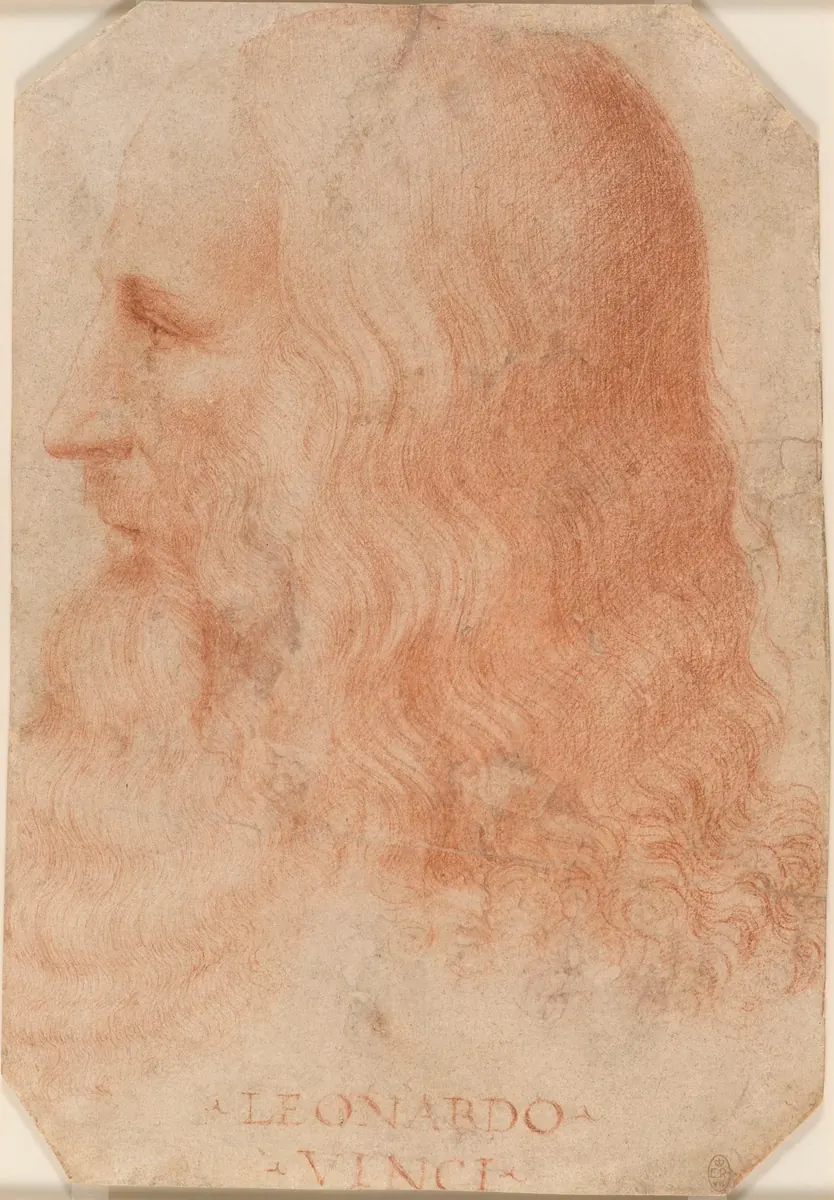
Portrait of Leonardo da Vinci attributed to Francesco Melzi. Historical red-chalk drawing.
Portrait of Leonardo da Vinci attributed to Francesco Melzi. Historical red-chalk drawing. Wikimedia Commons, public domain.

Why Leonardo

His questions travelled.

Leonardo is our inspiration because his questions travelled. He applied an artist's observation to anatomy, a mechanic's thinking to movement, and a student of water's insight to the heart. His work shows the possibilities of exchanging methods between disciplines.

It also reveals the distance between an ingenious idea and a useful application. Materials, power, testing, communication and the circumstances of a patron all mattered. Today, commercialisation needs evidence, a viable use case and partners able to implement it.

This exhibition explores 20 selected works and investigations from a much larger body of work. Some are finished masterpieces. Others are notebook proposals or observations. The modern industry connections are LDV's interpretations, not claims that Leonardo directly caused later technologies. Source: Royal Collection Trust: Leonardo's life.

Exhibit I

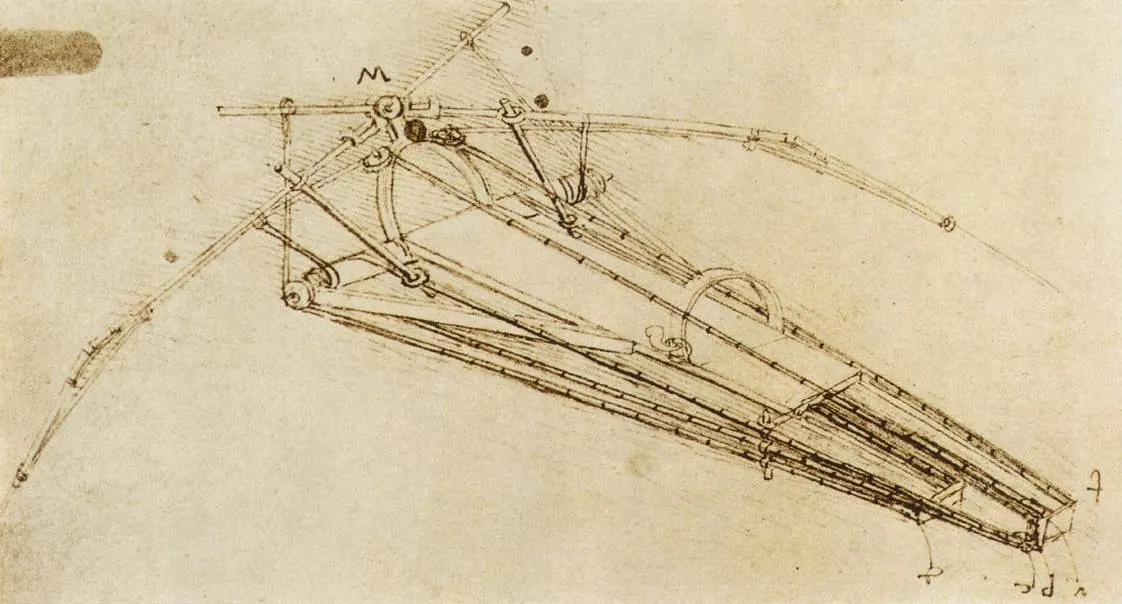
Interpretive model of an articulated flying machine. Motion illustrates the concept, not a validated flight mechanism.

Flight and airLate 1480s

Notebook design

The flying machine

Learning from the architecture of a wing

Leonardo translated the motion of birds into an arrangement of ribs, joints, cords and pulleys. The difficult question was whether a human could supply enough power.

Chapter 1 of 20
The LDV perspective

Biological structures can suggest new engineering approaches. Their usefulness depends on testing scale, energy requirements and operating conditions in the intended application.
His life

Seven places, one restless notebook.

Press a seal for a place; unroll the manuscript for the whole story.

The collection

Twenty chapters, six fields.

Choose a chapter to bring it into the case above.

The reason for Leonardo. The work of LDV.

The next application may be in another field.

A new use case begins with a connection. Commercial adoption takes the work that follows: evidence, a credible partner and a path both sides can act on.

He also reminds us that invention and adoption are different achievements. Many of his ideas remained in notebooks. Our work is directed at the next steps: finding a practical use, establishing evidence and helping the right organisations work together.

Sources and rightsHow this exhibition was made, and image credits

Historical accounts link to collection and museum sources in each chapter's full story. Dates are approximate where appropriate. Designs, observations and completed artworks are distinguished. The text does not claim that Leonardo invented the golden ratio, discovered the complete circulation of blood, or achieved powered human flight.

LDV's connections to modern industries are contemporary interpretations, not claims that Leonardo directly caused later technologies.

All interactive models are original explanatory illustrations made for LDV. They are deliberately simplified and are not validated museum reconstructions, working engineering designs or scientific simulations. Five chapters show archival works in a gilt frame; the other fifteen have explanatory models. Museum sources are credited for historical information; inclusion does not imply endorsement.

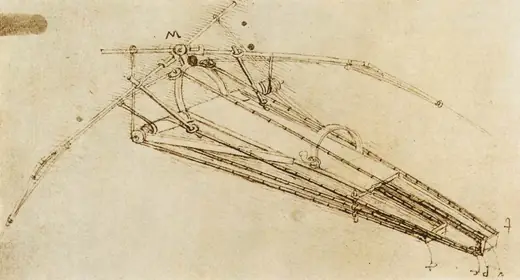
  1. I. The flying machine Leonardo da Vinci, study of a flying machine. Historical notebook drawing. Wikimedia Commons, Public domain.
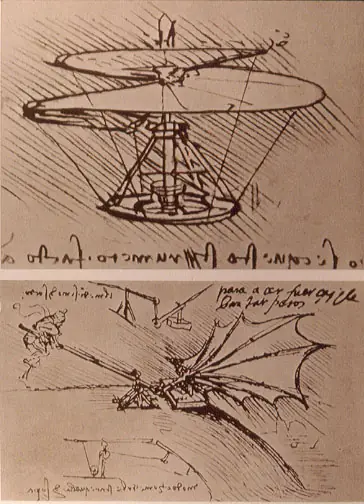
  2. II. The aerial screw Leonardo da Vinci, aerial screw and wing studies. Historical notebook drawing. Wikimedia Commons, Public domain.
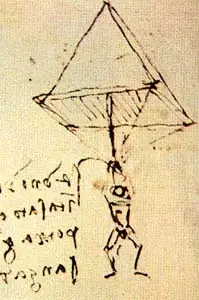
  3. III. The parachute Leonardo da Vinci, pyramidal parachute proposal. Detail of a notebook drawing; the surviving reproduction is small. Wikimedia Commons, Public domain.
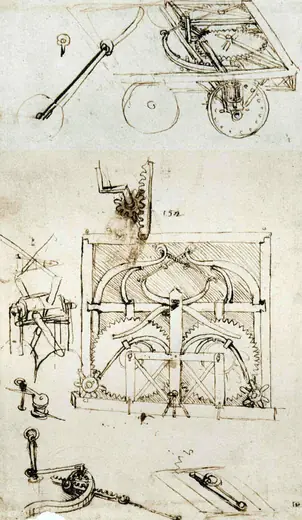
  4. IV. The self-moving cart Leonardo da Vinci, mechanical cart study. Historical notebook drawing. Wikimedia Commons, Public domain.
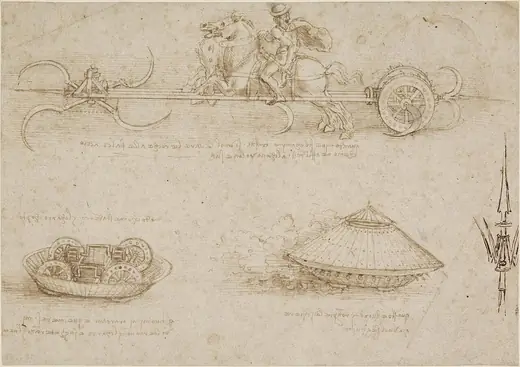
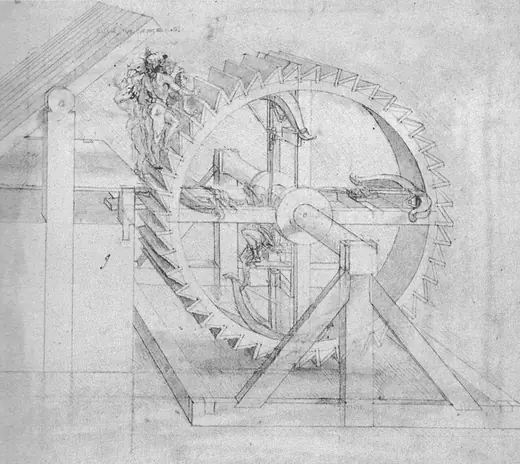
  5. V. The armoured vehicle Leonardo da Vinci, studies of military machines, including an armoured vehicle. British Museum, 1860,0616.99. Wikimedia Commons, Public domain.
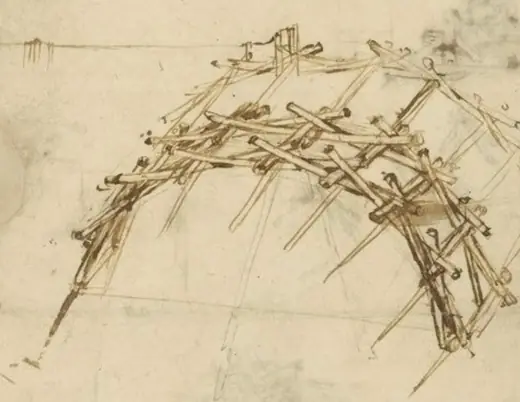
  6. VI. The interlocking bridge Leonardo da Vinci, study associated with an interlocking, self-supporting bridge. Historical notebook drawing. Wikimedia Commons, Public domain.
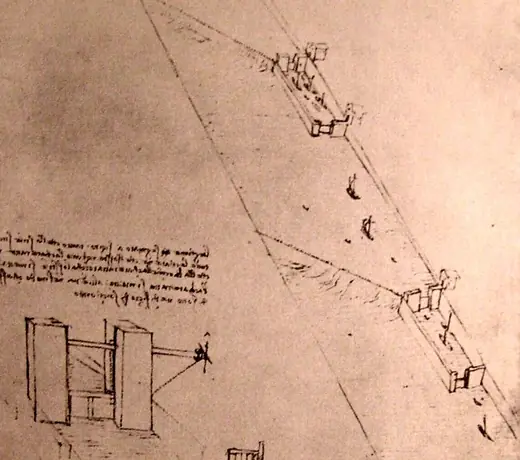
  7. VII. Canals and lock systems Leonardo da Vinci, canal and lock studies. Historical notebook drawing. Wikimedia Commons, Public domain.
  8. VIII. Gears and the language of motion Leonardo da Vinci, gear study. This reference illustrates his wider work on transmission; it is not the same arrangement as our model. Wikimedia Commons, Public domain.
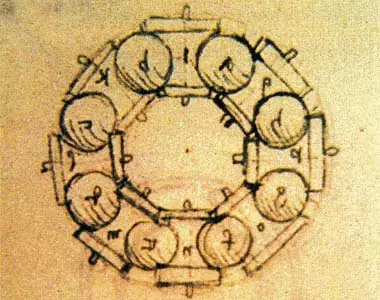
  9. IX. Rolling bearings Leonardo da Vinci, ball-bearing study. Historical notebook drawing. Wikimedia Commons, Public domain.
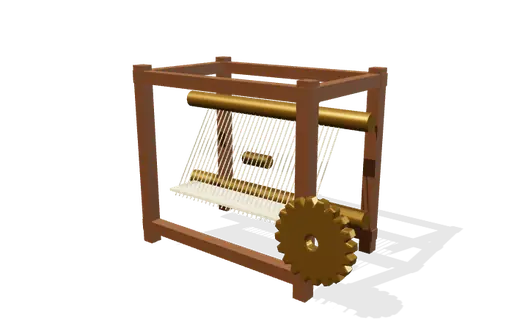
  10. X. The automatic weaving loom Original LDV explanatory rendering of a simplified loom. This is not an archival image or a validated reconstruction of Leonardo's design. Museo Leonardiano, Original LDV exhibition illustration.
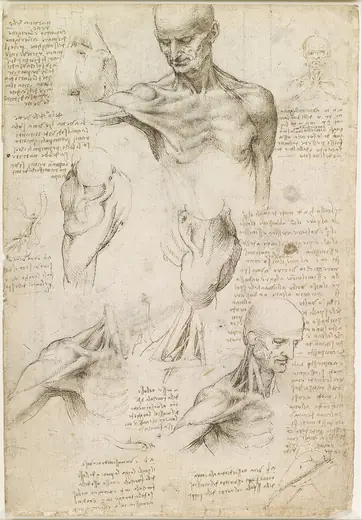
  11. XI. The body as a moving system Leonardo da Vinci, superficial anatomy of the shoulder and neck. Royal Collection. Wikimedia Commons, Public domain.
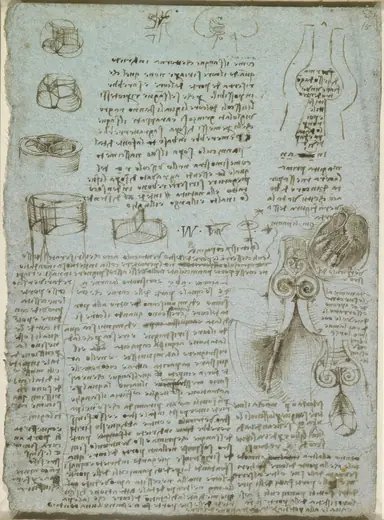
  12. XII. The heart and its valves Leonardo da Vinci, The aortic valve, c. 1512 to 1513. Royal Collection, RCIN 919082. Wikimedia Commons, Public domain.
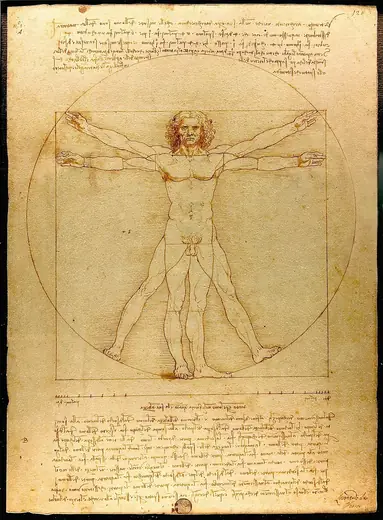
  13. XIII. Vitruvian Man Leonardo da Vinci, Vitruvian Man, c. 1490. Gallerie dell'Accademia, Venice. Reproduction by Luc Viatour. Wikimedia Commons, Public domain.
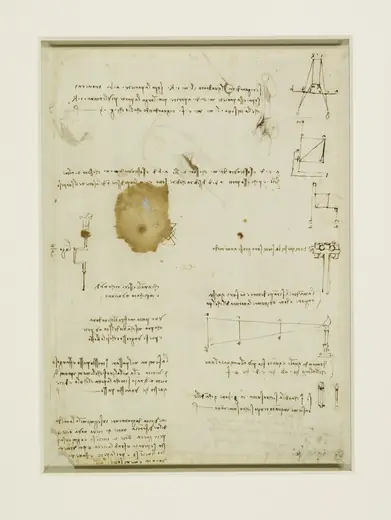
  14. XIV. Light, vision and perspective Leonardo da Vinci, studies of statics, optics and engineering. Royal Collection, RCIN 912351. Wikimedia Commons, Public domain.
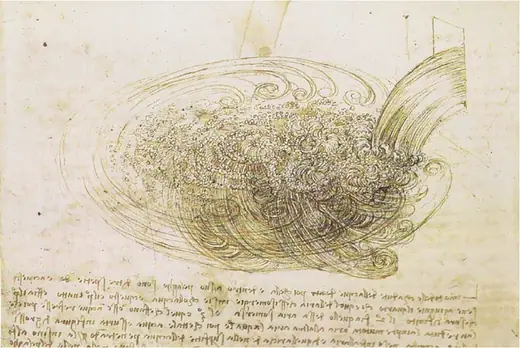
  15. XV. The motion of water Leonardo da Vinci, studies of water in motion. Historical drawing. Wikimedia Commons, Public domain.
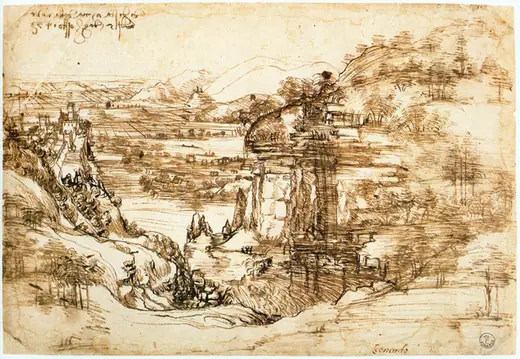
  16. XVI. Fossils and the changing Earth Leonardo da Vinci, landscape drawing dated 1473. Shown as context for his observation of terrain, not as a page from his fossil studies. Wikimedia Commons, Public domain.
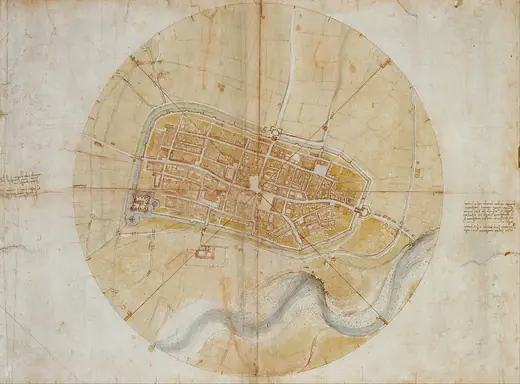
  17. XVII. The map of Imola Leonardo da Vinci, Plan of Imola, 1502. Royal Collection. Wikimedia Commons, Public domain.
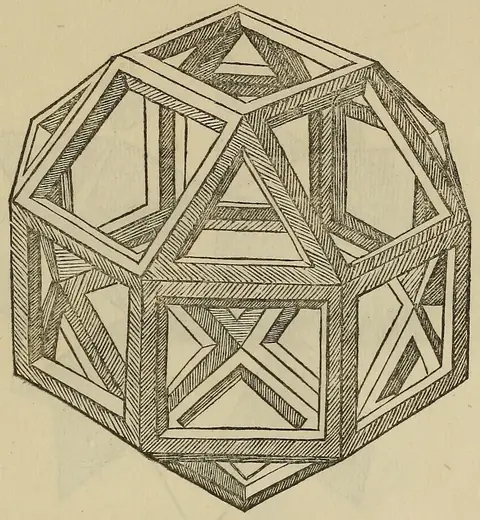
  18. XVIII. Geometry and the golden ratio Open rhombicuboctahedron from Luca Pacioli's Divina proportione (1509), after Leonardo's illustrations. Wikimedia Commons, Public domain.
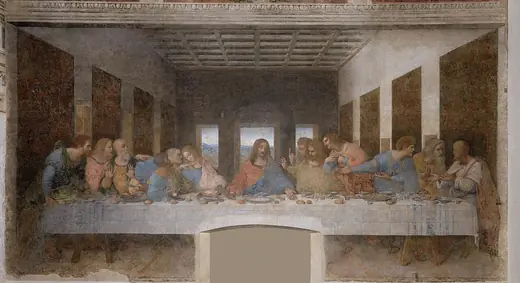
  19. XIX. The Last Supper Leonardo da Vinci, The Last Supper, 1495 to 1498. Reproduction of the surviving mural at Santa Maria delle Grazie, Milan. Wikimedia Commons, Public domain.
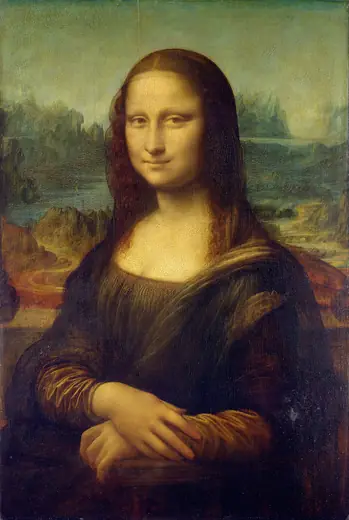
  20. XX. Mona Lisa Leonardo da Vinci, Mona Lisa, c. 1503 to 1519. Musée du Louvre. C2RMF reproduction. Wikimedia Commons, Public domain.